
- Type of object:Marble sculpture
- Measurements (H/W/D):99 cm / 81 cm / 37 cm
-
Materials & Techniques:
marble / sculpted
-
Inscriptions & Markings:
-
Date or Period:
1728 / Baroque period
- Maker:Robba, Francesco (1698 - 1757)
-
Subject:
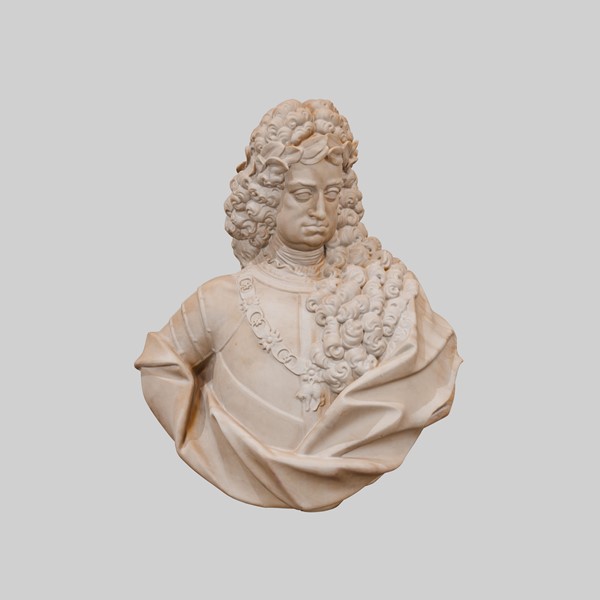
A bust of a male figure, emperor Charles VI.
- Title:Charles VI
-
Distinguishing Features:
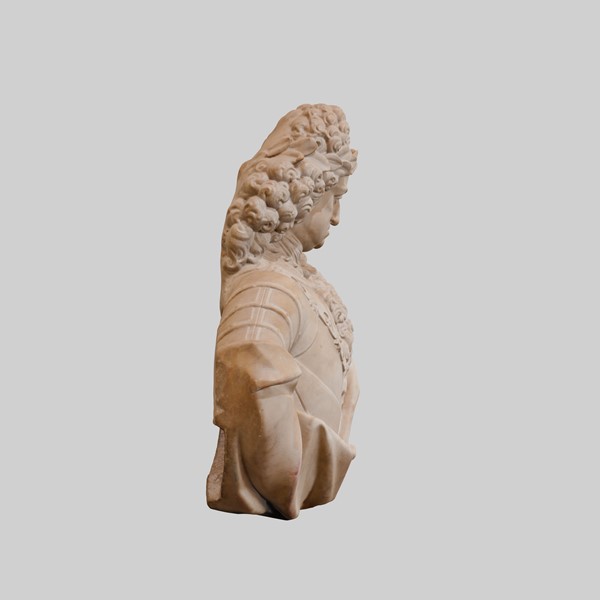
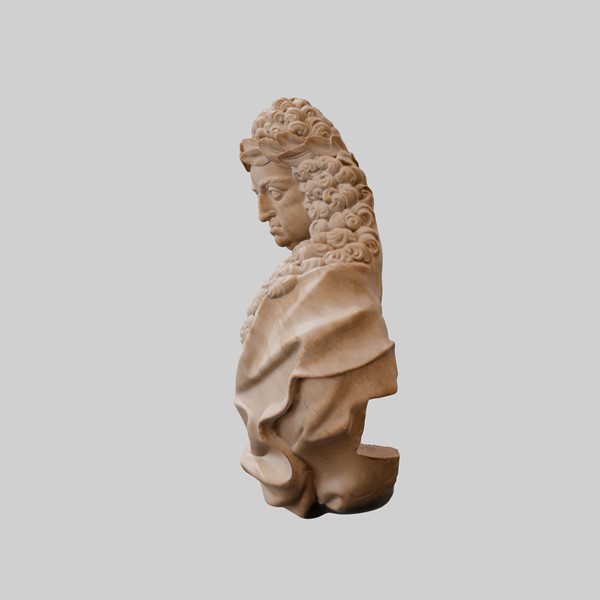
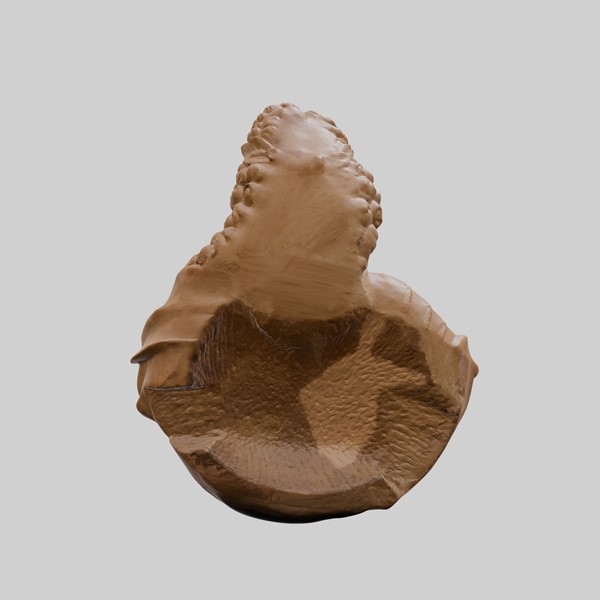
The sculpture is slightly chipped on the figure’s lower left part, on the edges on the drapery along the figure’s left side, on the bottom centre, on the drapery on his right elbow and on his right shoulder. There are traces of purple pigment on the edge of the drapery along his left side, and traces of purple and green pigment along the edge of the drapery on his right side. Fill-in material is visible on the drapery below the figure’s right elbow and on the bottom edge of the drapery. There is slight damage on the edge of the drapery on his left side.
A marble bust of emperor Charles VI made in 1728 by the Baroque sculptor Francesco Robba (1698 – 1757). The bust depicts a male figure of an emperor, dressed in armour with undergarment visible around his neck. Across his chest is a neck chain of the Golden Fleece, i.e. a collar with an insignia in the form of a sheepskin. He is wrapped in a rich drapery hanging across his left shoulder and around his waist. He has voluminous curly hair falling down his left shoulder and part of his chest. He has a laurel crown on his head. The sculpture was originally located on the Triumphal Arch at the City Gate (Vicedomska vrata) in Ljubljana until 1791. It was later housed in the Town Hall and is currently held at the City Museum of Ljubljana. There is a terracotta bust of Charles VI (1728) at the National Gallery of Slovenia, which probably served as a model for the marble bust. The terracotta bust is broken into several pieces.
A handheld structured-light 3D scanner Artec Space Spider II. The instrument quotes the following specifications: 3D point accuracy: up to 0.05 mm. 3D accuracy over distance: up to 0.05 mm + 0.3 mm/m. Working distance: 0.19–0.3 m. Linear field of view, H×W @ closest range: 128 × 104 mm. Linear field of view, H×W @ furthest range: 171 × 152 mm. Ability to use Photo Texture. Texture resolution: 5 MP. Colors: 24 bpp. 3D structured-light source: 450 nm LED.
A full-frame mirrorless interchangeable-lens camera Canon EOS R5 Mark II. The instrument quotes the following specifications:45.0 megapixel full-frame backside-illuminated stacked sensor. 8K RAW video up to 60p. DIGIC X processor with new DIGIC Accelerator chip. 8K raw video recording at up to 59.94 fps. 100% autofocus coverage. 0.5" 5.76 million dots OLED electronic viewfinder with 120 fps refresh rate and vari-angle LCD touchscreen.
-
Object ID No.:
-
Related Written Material:
-
Place of Origin/Discovery:
The sculpture was originally located on the Triumphal Arch at the City Gate (Vicedomska vrata) in Ljubljana until 1791. It was later housed in the Town Hall and is currently held at the City Museum of Ljubljana.
-
Cross Reference to Related Objects:
There is a terracotta bust of Charles VI (1728) at the National Gallery of Slovenia, which probably served as a model for the marble bust. The terracotta bust is broken into several pieces.
-
Date Documented:
2025-06-09