
- Type of object:Marble sculpture
- Measurements (H/W/D):169 cm / 72.5 cm / 47.5 cm
-
Materials & Techniques:
White marble / hand-carved, sculpted
-
Inscriptions & Markings:
S.ANDREAS APOSTOLVS / carved in gilded lettering on the rim of the plinth
-
Date or Period:
18th century (app. 1728) / Baroque period
- Maker:Robba, Francesco (1698 - 1757)
-
Subject:
A marble sculpture of an angel
- Title:St Andrew the Apostle
-
Distinguishing Features:
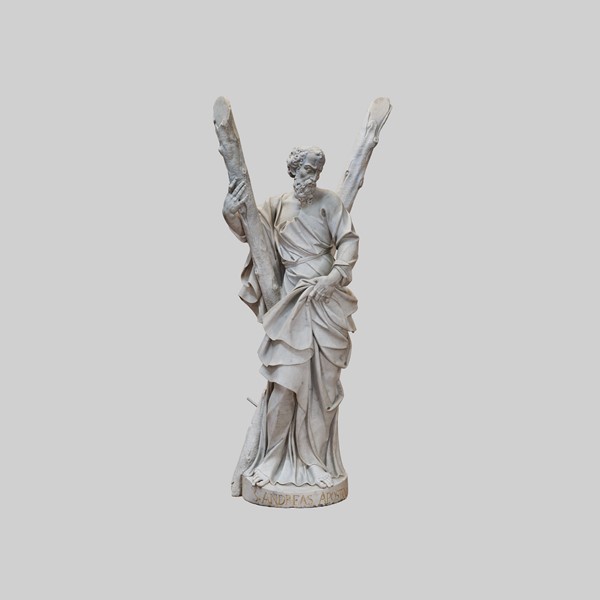
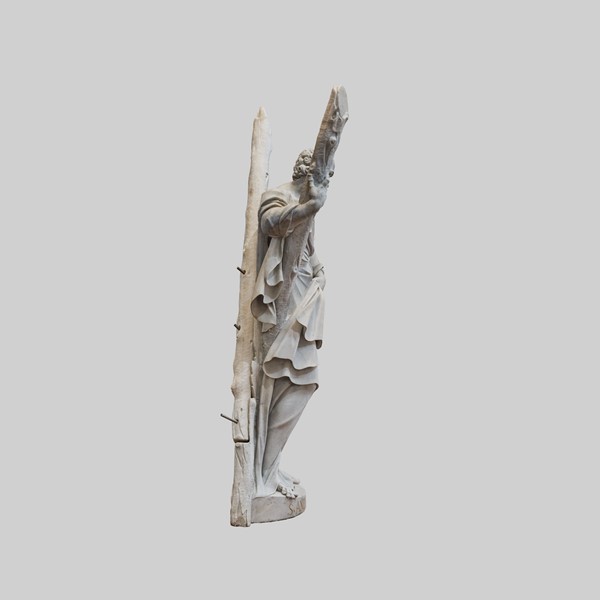
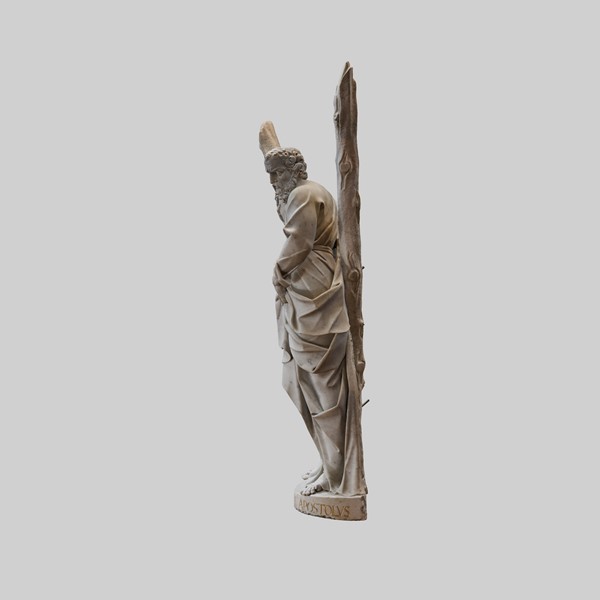
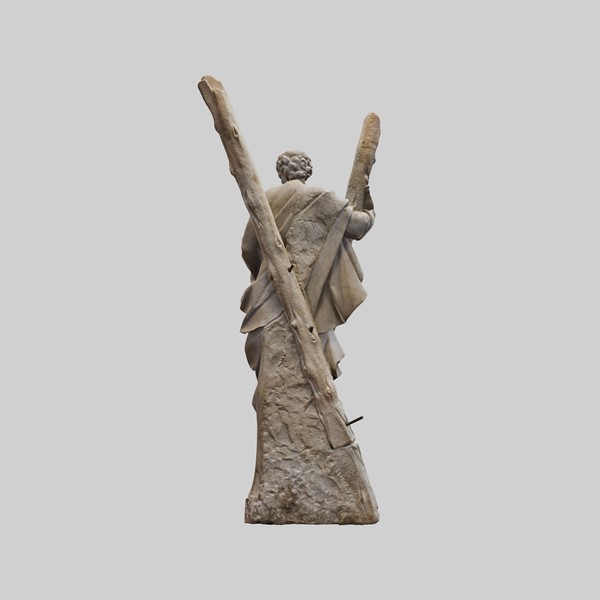
A circular hole is visible at the top of the head, probably intended for the attachment of an additional element. Three holes are located on the reverse side of the figure, serving to attach the cross. The statue was damaged during the 2020 earthquake and was subsequently treated at the Croatian Conservation Institute in Zagreb, where conservation and restoration works have been completed. The interventions are visible across the entire sculpture. The beard appears to have been reattached, with visible restoration material along the join. A restoration fill line is visible at the junction between the neck and the head. A small, negligible patch of fill material is present above the figure’s left eyebrow. Repair material is visible along the brim of the drapery in the lower part of the sculpture and on the two pieces that make the cross. Below the right knee, on the inner side of the drapery, there is an opening with probable traces of repair material.
The marble statue of saint Andrew the Aposle, sculpted by the Baroque sculptor Francesco Robba (1698 – 1757). The sculpture was originally part of the altar of St. Catherine in Zagreb cathedral, but was transferred to the parish church in Sisak in 1885. The sculpture depicts saint Andrew the Apostle, a bearded male figure dressed in flowing robes, resting on a diagonal cross - a large Y-shaped piece of wood. In his left hand, at waist level, he holds his pleated robes. His right arm is wrapped around the upper left arm of the cross. His gaze is directed slightly down. The Y-shaped piece of wood represents a saltire, the cross on which saint Andrew was crucified. At the bottom, his bare feet can be seen looming from underneath his robes. The figure is standing on a semicircular stone plinth. The name of saint Andrew the Apostle is carved in gilded lettering into the stone plinth. The statue was damaged during the 2020 earthquake and was subsequently treated at the Croatian Conservation Institute in Zagreb, where conservation and restoration works have been completed.
A handheld structured-light 3D scanner Artec Leo. The instrument quotes the following specifications: 3D point accuracy: up to 0.1 mm. 3D accuracy over distance: up to 0.1 mm + 0.3 mm/m. Working distance: 0.35 – 1.2 m. Linear field of view, H×W @ closest range: 244 × 142 mm. Linear field of view, H×W @ furthest range: 838 × 488 mm. Ability to use Photo Texture. Texture resolution: 2.3 MP. Colors: 24 bpp. 3D structured-light source: VCSEL.
-
Object ID No.:
-
Related Written Material:
Klemenčič, M., Francesco Robba in beneško baročno kiparstvo v Ljubljani, Ljubljana, 1998. Klemenčič, M., Francesco Robba (1698–1757). Beneški kipar in arhitekt v baročni Ljubljani, 2013.
-
Place of Origin/Discovery:
The sculpture was originally part of the altar of St. Catherine in Zagreb cathedral, but was transferred to the parish church in Sisak in 1885. The statue was damaged during the 2020 earthquake and was subsequently treated at the Croatian Conservation Institute in Zagreb, where conservation and restoration works have been completed.
-
Cross Reference to Related Objects:
The sculpture of St Francis de Sales was originally part of the same altar of St. Catherine from the Zagreb cathedral.
-
Date Documented:
2025-10-27